Mildred Thompson (1936 - 2003)
Born: Jacksonville, Florida, America
Multi- Disciplined Artist: painting, drawing, printmaking, sculpture, and photography.
Canon: The National Museum of Women in the Arts (NMWA) documents more than 5,000 works over four decades.
“My work is a continuing search for understanding relationships in the universe” — Mildred Thompson
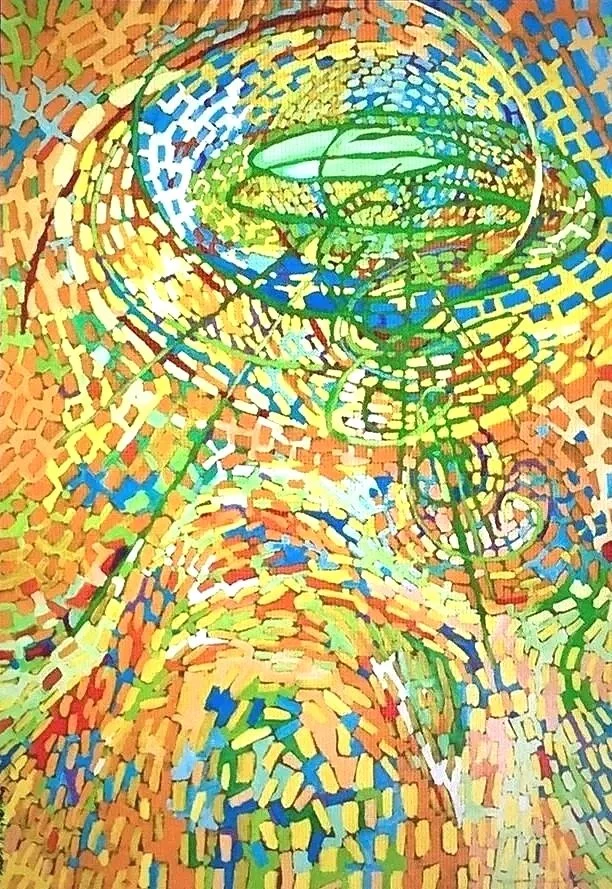
Mildred Thompson, Becoming (1958). Image courtesy of Wikimedia Commons,
licensed under CC BY-SA 4.0. Cropped for presentation.
Experimenting the Way
Mildred Thompson was mentored by art historian, artist and teacher James A. Porter. His guidance helped shape her early experiments with abstraction, encouraging her to look beyond the confines of a single artistic discipline and the expectations of the time. Perhaps it was here that she began to develop the confidence to follow her own artistic calling, without allowing labels or stereotypes to define its direction.
Mildred met James at Howard University in Washington, D.C, in 1953. An advocate of her evolving work, James helped Mildred secure scholarships at the Skowhegan School of Painting and Sculpture in Maine and the Brooklyn Museum School, where she received the Max Beckmann Scholarship.
Against a backdrop of segregation and growing civil rights unrest, Mildred sought greater artistic freedom and the opportunity to nourish her art and the purpose that was beginning to emerge through her work. Her first attempt to secure a Fulbright scholarship to study in Europe was unsuccessful. Nevertheless, she saved every penny to afford a steamship passage to Germany, setting off with a 'see what happens' attitude. Other than a few German lessons to help her settle in, Mildred was unsure how events would unfold, but she had faith in the strength of her portfolio. To her good fortune, she was accepted into the Hamburg Academy of Fine Arts, where she could continue her artistic pursuits and be critiqued on the merit of her work.
She learned etching, printmaking, lithography, and painting expanding her craft and continuing her artistic development under the guidance of European artists, including Willem Grimm, Paul Wunderlich, Walter Arno and Emil Schumacher.
Feeling inspired, Mildred decided to return to New York City in 1961, hopeful that the positive reception her work had received in Europe would translate to the New York art scene. This was not to be. She encountered many of the same racial and gender barriers that had previously limited opportunities for Black women artists in America. Among the many disheartening responses, however, she did receive some recognition in her homeland. William S. Lieberman, an influential curator at the Museum of Modern Art in New York, helped facilitate two purchases of her work.
The mixed reception received at the time informed her decision to relocate, once again, back to Germany and continue exploring her own creative direction. To be critiqued on her work alone was what Mildred strived for, and what any artist would hope for when pursuing a deeply rooted connection to their creative practice.
Having explored figuration through painting, drawing and etching early in her career, Mildred moved on to found wood and sculptural assemblages during the 1960s and early 1970s. By the mid-1970s, abstraction became a more focused direction, with her fully committing to abstraction from the 1980s onwards.
Return to America
With renewed optimism, Mildred returned to America in the mid-1970s, believing the climate had improved. She continued to build her career, including an artist-in-residence position at Howard University in 1977–78.
In 1981, she returned to Europe, this time to Paris, where she opened a studio on Rue de Parme eager to create further opportunities. With exhibitions and opportunities opening up, this was a period in which Mildred was finding her stride, developing an increasingly expressive visual language and continuing to explore abstraction on her own terms. By 1986, Mildred accepted an artist in residence position at Spelman College and settled in Atlanta.
“Her view was long — looking both to the ancient past and to the future and it was wide —looking deep into the earth and under the skin and far out into the cosmos.
She did not like boxes, labels or restrictive frameworks. Her intrepid nature is evident in the boldness of the work and the breadth of her references. “
— Melissa Messina curator of the Mildred Thompson Estate.
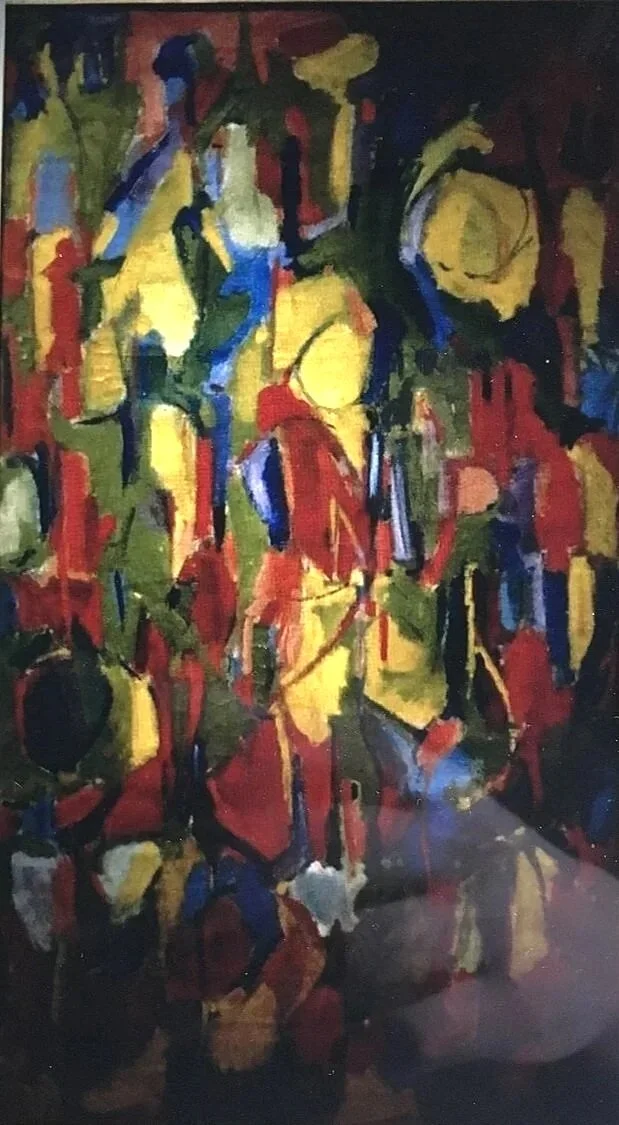
Mildred Thompson, The Becoming (1958), oil on canvas. Image uploaded to Wikimedia Commons by JJCC123456789, licensed under Creative Commons Attribution-ShareAlike 4.0 International (CC BY-SA 4.0). Image cropped for presentation.
Art for art's Sake
Rather than accommodate the expectations placed upon her at the time, she persisted in investigating and voraciously pursuing the deeper calling that was inviting her in.
Mildred Thompson African American Artists on Paper from the Cochran Collection. 1989
The Five Mysteries Series (1989)
Music, Sound and Visual Rhythm
Thompson was interested in patterns that recur in music and nature, exploring the relationship between jazz, classical music and visual rhythm. Translating sound into colour, rhythm and movement allowed her interest in musical structures a visual outlet.
Not only was she a listener and researcher, but also an amateur musician. She studied French horn in her youth before later taking up classical guitar. These experiences helped her explore and combine her passions through painterly repetition, variation and pattern.
Music of the Spheres
“She studied Pythagoras and Kepler, fairy tales and the old testament, early 20th century theosophers P.D. Ouspensky and Rudolph Steiner, quantum physics from relativity to string theory, and music from Beethoven and Bach to Charles Mingus and Thelonious Monk. Her artistic influences were just as varied. She has cited Wassily Kandinsky, Paul Klee, Alma Thomas and Louise Nevelson pretty regularly, but there are others.”
— Melissa Messina in The Art Section.
The Language of the Invisible
From Third Octave I (1983), an abstract painting whose title invites us to explore the relationship between sound and visual rhythm, to The Five Mysteries (1989, video above), exploring schematic representations of the Earth, atmosphere and Sun, Mildred's interest in universal relationships becomes increasingly evident.
Pleiades III (1988) also brings astronomy into the picture. The Pleiades are a star cluster, also known as the Seven Sisters. The work offers an opportunity to explore her interest in celestial organisation and the relationship between individual forms and larger systems.
With Magnetic Fields (1990–92), Thompson investigated magnetic fields, translating these invisible forces into the colour yellow. Then, in 1993, she experimented with Helio-Centric vitreographs, exploring planetary revolution around the sun. Quantum mechanics and Kepler's ideas about planetary motion and harmony provide an interesting context for these investigations.
Moving on to Radiation Explorations (1994–95, No.11 painting via link), Thompson visualised the unseen through electromagnetic energy, using blue and the relationship between colour, shape and line to create immersive atmospheres.
In 1996, she created Music of the Spheres, a series of four monumental triptychs, each associated with a planet. My personal favourite is Music of the Spheres: Mars (1996), represented in red. Curator Melissa Messina explains that the palettes and forms were based on the vibrational frequencies of planetary orbits. Drawing on ideas associated with Pythagoras and Kepler, alongside her interests in classical and jazz music, Thompson explored the relationship between sound, vibration and the cosmos.
String Theory became a new investigative pursuit in 1999, as Thompson explored ideas about the fundamental structure of matter and the possibility that particles could be understood as tiny vibrating strings. The relationship between vibration and sound offers another fascinating connection. String Theory XI painting displays a vibrant, energetic convergence of painterly repetitions, forming a harmonious composition.
In First Magnitude (2002), one of her later works, we see a softer approach, with watercolour-like forms and colour fields bleeding into one another, leaving yet another energetic imprint within a robust catalogue of works spanning multiple mediums, before ultimately finding a home in abstraction.
Wisdom Transferred
Teaching throughout her career, Thompson would go on to develop two courses at the Atlanta College of Art: Making the Invisible Visible and Music Matters.
In the course syllabus, Thompson wrote: “Music is considered by some belief systems to be a path to invisible, parallel worlds.”
One thing that strikes me about Mildred's work is her determination to stay true to the purpose she felt compelled towards, and the stamina required to persist amidst external noise while producing such a substantial body of work. Equally intriguing is her inquisitive mind, one that seemed to delight in and devour so many subjects, gathering a breadth of material to explore and express through her art.
I am thrilled to have discovered this artist only last week. If you feel compelled to dive further into Mildred's world of art, I encourage you to visit the website links below:
The Art Section — Mildred Thompson
ICA Miami — Mildred Thompson: Frequencies