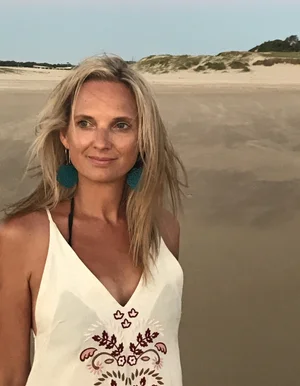
Ruth Asawa: Intricate By Nature

“When you put a seed in the ground, it doesn’t stop growing after eight hours. It keeps going every minute that it’s in the earth. We, too, need to keep growing every moment of everyday that we are on the earth.”
Ruth Asawa
Ruth Asawa, Untitled (S.383, Wall-Mounted Tied Wire, Open-Center, Six-Pointed Star, with Six Branches), c. 1967. Photograph by Xyz1018, Image source: Wikimedia Commons Licence: CC BY-SA 4.0. Image not edited. Artwork © Ruth Asawa Lanier, Inc./Artists Rights Society (ARS), New York. Courtesy David Zwirner.
The Early Years
Ruth Asawa was born into a Japanese immigrant family and grew up on a truck farm in Norwalk, California, immersed in nature, hard work and the rhythms of early morning rises to late sun-down finishes, six days a week. Although the work was demanding, nature was her teacher and ally.
At 16, her family would face internment and relocation to a Japanese American incarceration camp in 1942. Following Japan's bombing of Pearl Harbor during World War II, the farm, family home and ordinary life she had known were suddenly gone.
Although the displacement from her early farm life would have been incredibly frightening for the whole family, her relocation to the Rohwer War Relocation Center in Arkansas would become a pivotal rupture in her existing routine, one that unexpectedly expanded her exposure to art and new ways of learning.
At Rohwer, Asawa was introduced to informal drawing classes, including instruction from animators who had worked for Walt Disney Studios and were themselves incarcerated. For a young woman accustomed to the physical demands of farm life, art offered a different way of engaging with the world: a new way of doing, learning, observing and beginning to unpack life through making.
“Sometimes good comes through adversity. I would not be who I am today had it not been for the internment, and
I like who I am.” — Ruth Asawa
Asawa was awarded a scholarship to Milwaukee State Teachers College, where she pursued her ambition to become a teacher. However, anti-Japanese discrimination would once again redirect her path. Unable to secure the student teaching placement required to complete her qualification, Asawa left the college.
Black Mountain College
This redirection would transport her to her most transformational creative period yet: Black Mountain College in North Carolina. An experimental college built around interdisciplinary learning, Black Mountain brought Asawa into the orbit of modernist and colour theorist Josef Albers, inventor, designer and architect R. Buckminster Fuller, and other artists and thinkers who encouraged students to question how they learned, made and experienced the world.
Asawa would later describe a philosophy she absorbed from these teachers. Rather than imposing an idea upon a material, the artist could take a backseat and allow the material itself to reveal what it could become. The artist becomes less the author imposing an outcome or ideas and more a participant, observing, responding, extracting what is already there and caring for the material through the process like that of a parent.
This way of thinking would become fundamental to Asawa's practice. Her teachers were deeply interested in ideas that had not yet taken shape, and that spirit of experimentation would stay with her: curiosity before certainty, process before outcome, and an openness to discovering what the material might teach her.
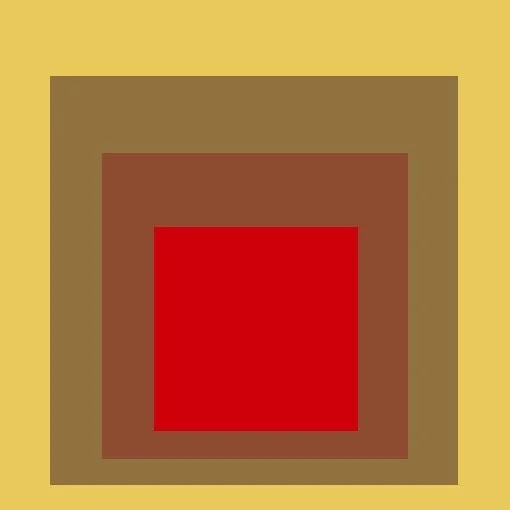
Josef Albers (1888-1976) taught at Black Mountain College until 1949.
“I was for years in the yellow period, you know.”
Graphic after Josef Albers, Homage to the Square (1967).
Image by FriedeWie, Wikimedia Commons, CC0. Image unedited.
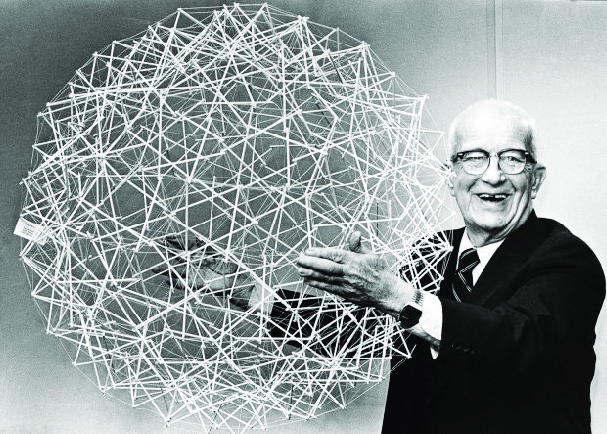
J. Buckminster Fuller (1895-1983) taught at Black Mountain College during the Summers of ‘48-’49.
“When I am working on a problem, I never think about beauty. I think only of how to solve a problem. But when I have finished, if the answer is not beautiful, I know it is wrong.”
R. Buckminster Fuller holding a geodesic tensegrity sphere, Wikimedia Commons, CC BY 4.0. Image unedited.
The Technique
In 1947, Asawa travelled to Toluca, Mexico, where she discovered a wire basket at a local market. Fascinated by the technique, she sought out the maker and asked to be taught how to create the looped-wire form.
Asawa now had a technique to explore. It was simple in principle, but it offered almost endless possibility. With patience, repetition and experimentation, she began to transform the humble loop into increasingly organic and intricate three-dimensional forms.
Her sculptures would eventually be suspended from the ceiling, allowing space, movement, light and air to become active participants in the work. Rather than occupying space as solid objects, the open forms seemed to dissolve and reform as the viewer moved around them, their shadows and reflections extending the sculpture beyond its physical boundaries.
“It only takes one technique to lose yourself in it and get lost in translation, taken for a ride.”
— Ruth Asawa
Asawa's technique was taking shape, and so too was her life. She met Albert Lanier, another student at Black Mountain College, who would later become an architect. They married in 1949, settled in San Francisco and eventually had six children.
What is fascinating is how deeply Asawa's artistic practice was embedded within family life. She continued to draw, experiment and make while raising her six children, creating a home in which art was not separated from the everyday. Her studio became part of family life, and her children grew up surrounded by the processes of making, observing and experimenting.
Her eldest daughter, Aiko Cuneo, recalled that Asawa was an insomniac who would often work late into the night requiring very little sleep, sometimes only four hours before returning to the demands of family and studio life.
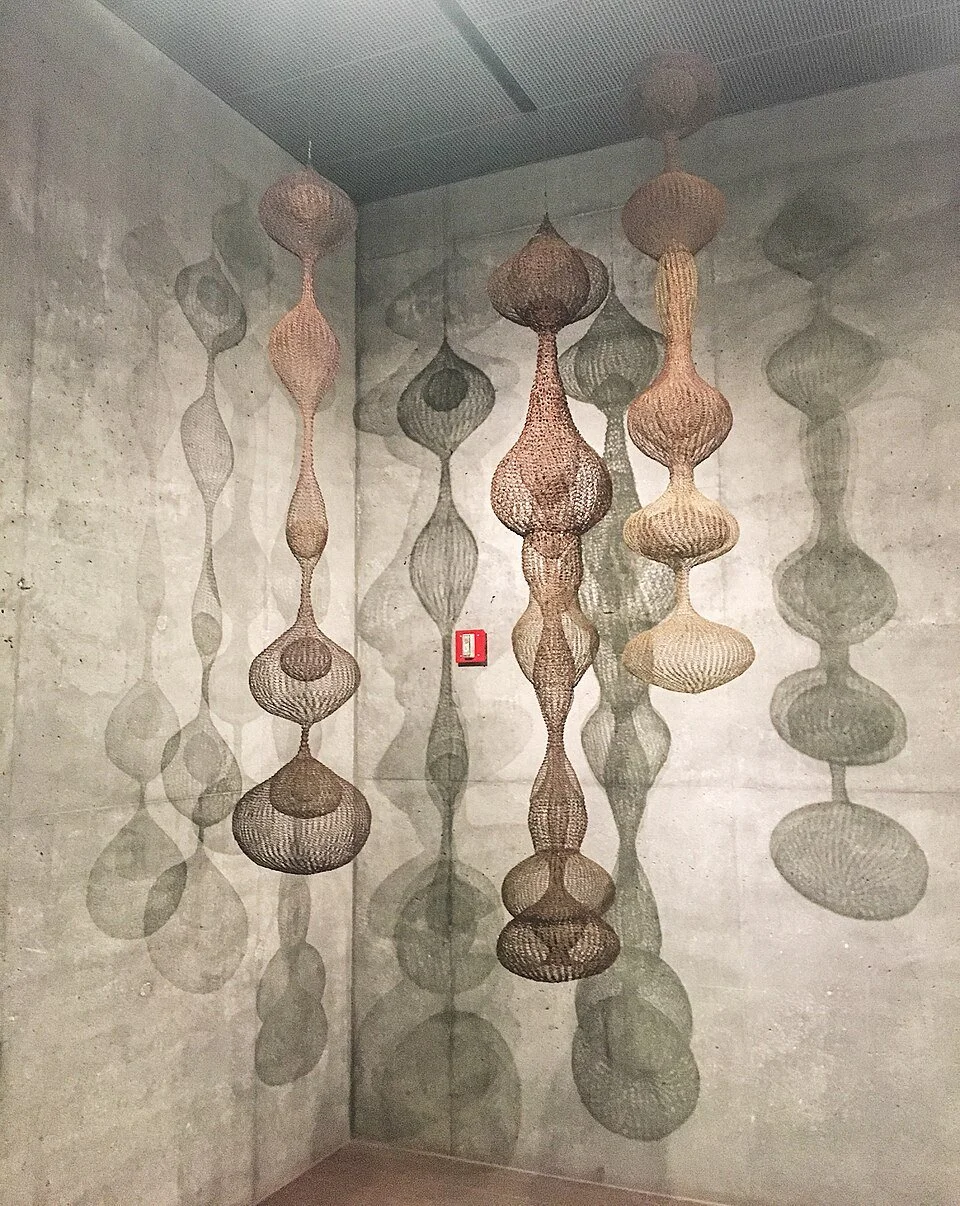
The looped-wire sculptures that emerged from this period depended upon transparency. Light and air could pass through their forms, while shadows were cast onto the surrounding surfaces. The space around the sculpture was no longer simply a backdrop; it became part of the work.
The viewer, too, became part of this exchange, moving around the sculpture, watching it change with light, shadow and perspective. Asawa had begun with a simple technique, but through repetition and attention she discovered an entire language of form, space and movement.
Ruth Asawa, Untitled, de Young Museum Permanent Collection. Photograph by Alexandra Courtis, 2019. Image source: Wikimedia Commons Licence: CC BY-SA 4.0. Image unedited.
Community and Arts Education
It is important to note that the desire to teach never left Asawa and remained integral to her creative engagement throughout her life. Community, inclusivity and experimentation through art became central to her life's work, a way of passing on the joy, curiosity and sense of possibility that had woven their way into her own life through so many unexpected redirections.
Her commitment to arts education began close to home. Asawa became involved in her children's public school, teaching art through hands-on experimentation with inexpensive, everyday materials. Disappointed with the public school’s lack of quality arts education, this led to the co-founding of the Alvarado School Arts Workshop in 1968, which eventually brought artists into public schools across San Francisco. Her advocacy would culminate in the establishment of the city's first public arts high school in 1982. Now renamed the Ruth Asawa San Francisco School of the Arts in her honour in 2010.
So what can we take from Ruth Asawa?
Suspension. Transparency. Space.
Let light and air become part of the work. Or, in two-dimensional work, consider the relationship between positive and negative space.
Art as a way of seeing and living.
Stay curious. Observe. Make. Learn.
Organic form. Room for growth.
Start with a technique. Look into the ordinary and let the extraordinary unfold, a plethora of possibilities to tap into.
Community and inclusion.
Share your work with others. Find your creative community and make space for others within it. Teach what you know.
Art doesn't have to begin with an outcome. It can begin with curiosity, experimentation, connection and the simple act of making.
If you'd like to explore your own intuitive creative practice, our free Intuitive Art as Medicine offers a space to experiment, discover and reconnect with your creative voice.