P.J. Harvey: Poetic 50ft Queenie
For Gen Xers, Polly Jean Harvey was our Patti Smith meets Joni Mitchell, our English Rose, our 50ft Queenie.
I remember in high school, my best friend and I would hang out. She was into the heavier side of music, and always trying to get me to go to a Pantera gig. It was a flat no, not to my taste, thank you. But I heard her playing P.J. Harvey's Dry CD constantly on the playlist, and would often holler, “But, I like this!”
It wasn't quite Pantera, but she had found the sweet spot of our musical friendship, and over time, discovered just how far she could push me towards the concerts she'd choose and the stages we'd adventure to at the Big Day Out. I would go on to see Harvey live at The Palais in, Melbourne, (2001, 2003) and the Big Day Out. There is something about a confident woman walking onto a stage with an electric guitar, a short skirt and ridiculously high heels, commanding an audience's attention. It was exciting. It was motivating. And, as a young creative woman watching her, it awakened all the creative sparks nested deep within me, urging them to find an outlet.
Harvey released Dry in 1992, following a few years of playing guitar and saxophone in bands around her hometown of Dorset, England. The album began as a trio, with longtime collaborator and friend John Parish on guitar and Rob Ellis on drums.
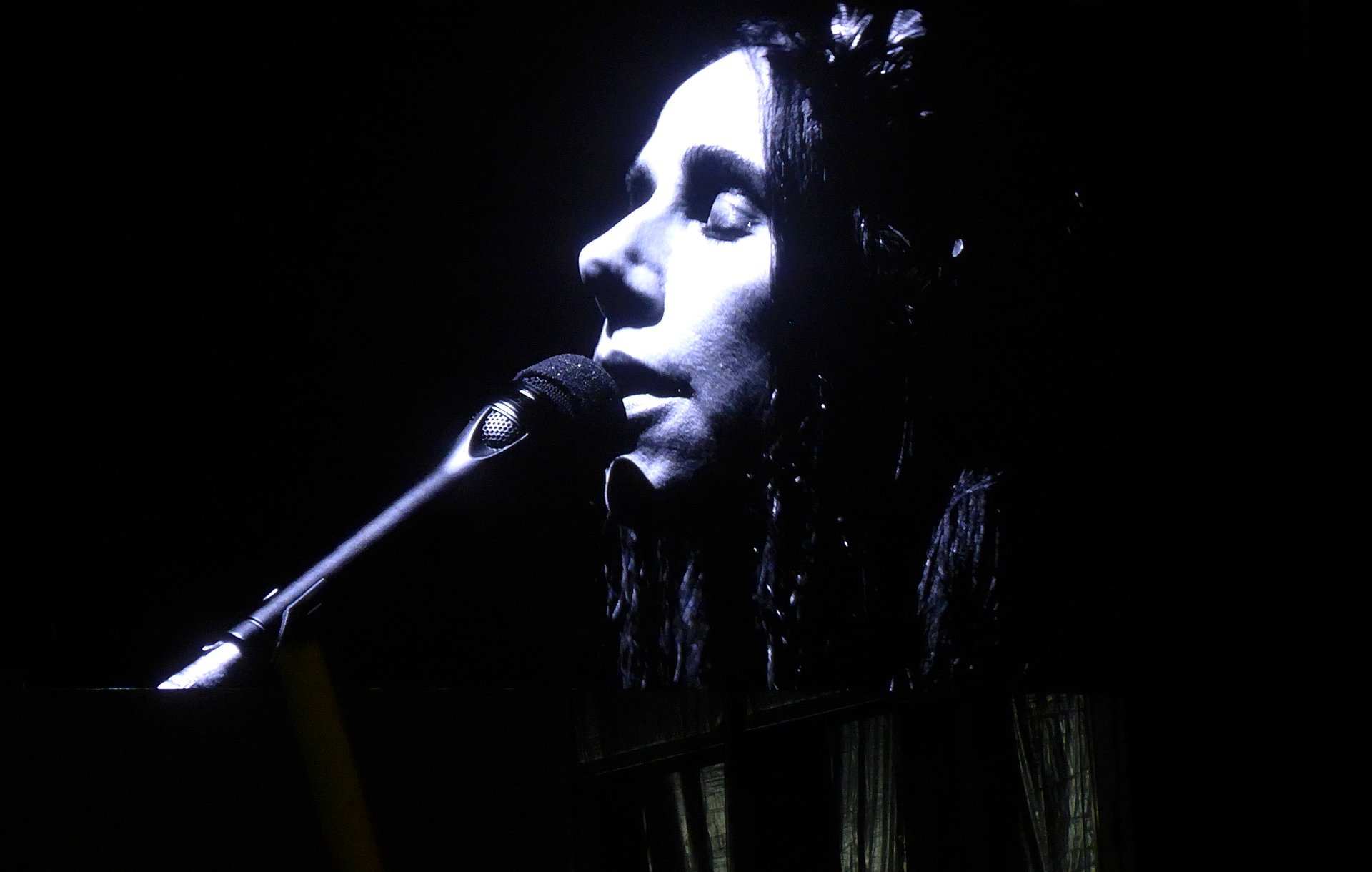
P.J. Harvey performing at Primavera Sound, Barcelona, 4 June 2016. Photo: Raph_PH, via Wikimedia Commons.
The follow-up album, Rid of Me, arrived at a timely moment. Grunge was in full swing and audiences were hungry for something raw, loud and uncompromising. Harvey delivered exactly that, although she was never simply another voice in the grunge movement. Rolling Stone would name Harvey Songwriter of the Year and Best New Female Vocalist. The trio disbanded, and what had begun as a trio was now officially a solo career.
“As a writer, I want extremes in the lyrics as well.”
— P.J. Harvey, 1992
Listen to Sheela-Na-Gig, video clip (left), from the Dry album.
P.J. Harvey, Solo Career
Parish would go on to tour with Harvey as she established herself as a solo artist, alongside Bad Seeds multi-instrumentalist Mick Harvey.
To Bring You My Love and Is This Desire? delivered raw, confrontational explorations of desire, sexual power, obsession, dependency, female anger, agency, vulnerability, power dynamics and the body.
Again, Rolling Stone recognised Harvey, naming her its 1995 Artist of the Year, while To Bring You My Love was named Album of the Year. “Down by the Water” received extensive MTV play, helping propel the album to a much wider audience.
Could we even call 50ft Queenie the answer to Soundgarden's Louder Than Love?
“I enjoy looking like a tart and thinking like a politician.”
— P.J Harvey, 1995
Harvey has commented that many of the songs from this period were written with humour, even though the lyrics were often examined through a much more serious lens.
We can see this play out in “50ft Queenie”. As the grunge era gathered momentum, Harvey took to the stage as an exaggerated, provocative character, confident, sexually charged and entirely in command. In a male-dominated rock culture, she wasn't asking for a seat at the table; she was taking the stage and turning the volume up herself.
Mercury Prize Winner, 2001
Having explored desire, power, sexuality and life as a woman navigating a male-dominated industry, P.J. Harvey then deliberately moved towards something different. With Stories from the City, Stories from the Sea, she explored love, freedom, vulnerability and possibility, drawing inspiration from places including Dorset, Paris and New York.
These themes were deliberately wrapped in musical compositions of extraordinary beauty, creating a striking contrast to the more challenging realities she so often writes about. And then, in a strange collision of art and real life, one of the album's defining moments would coincide with one of history's darkest days.
Harvey was awarded the Mercury Prize for Stories from the City, Stories from the Sea on 11 September 2001, the same day the terrorist attacks in the United States changed lives and profoundly altered perceptions of the world we lived in. One can only imagine the surreal contrast of receiving one of music's most significant honours on a day when the world outside was being transformed.
Harvey would invite Thom Yorke to sing on the prize-winning album, Stories from the City, Stories from the Sea, on ‘This Mess We’re In’. He also provided backing vocals for ‘One Line’ and ‘Beautiful Feeling’. The duo refreshingly brings a wonderful combination of hauntingly beautiful emotive depth, journeying through the call-and-response style of their lyrics.
“By putting myself in unfamiliar situations, it does force one to look at things with a new perspective, not to take things for granted.”
P.J. Harvey on spending seven months abroad in NYC and how that inspired certain writing themes.
Listen to the complete album song list.
Harvey would then release Uh Huh Her (2004) returning to her raw, guitar driven roots before following up with White Chalk (2007), almost an alternate universe to her previous work, introducing the autoharp and a collection of mainly piano-led ballads.
Collaborations
P.J has had a run of fruitful collaborations with various artists over her evolving career. I have constructed a list below:
Björk — ‘I Can’t Get No Satisfaction’, BRIT Awards — 1994
Philip Ridley — ‘Who Will Love Me Now?’, The Passion of Darkly Noon — 1995
John Parish — Dance Hall at Louse Point — 1996
Nick Cave & The Bad Seeds — ‘Henry Lee’ — 1996
Pascal Comelade — ‘Love Too Soon’ — 1998
Tricky — ‘Broken Homes’ — 1998
Thom Yorke / Radiohead — ‘This Mess We’re In’ — 2000
Sparklehorse / Mark Linkous — ‘Piano Fire’ & ‘Eyepennies’ — 2001
Josh Homme / The Desert Sessions — ‘Crawl Home’ — 2003
Marianne Faithfull — Before the Poison (album) — 2004
Mark Lanegan — Bubblegum (album) — 2004
Mick Harvey — ‘Slow-Motion Movie-Star’ — 2007
John Parish — A Woman a Man Walked By (album) — 2009,
Ben Waters — ‘Lonely Avenue’ — 2011
Ramy Essam — ‘The Camp’ — 2017
Elvis: A Fascination Woven Through Written Dreaming
Another interesting detail that was woven into Stories from the City, Stories from the Sea is the Elvis Presley influence behind the costume for the “This Is Love” video (left). The form-fitting white suit, designed by Todd Lynn, was inspired by Elvis, with fringing along the sleeves, paired with PJ’s trademark stilettos and red lipstick.
Harvey has spoken about her childhood fascination with Elvis, her interest in older films featuring James Dean, and her admiration for the beauty and soulfulness of Elvis’s voice, and his primal stage presence.
This fascination has remained a thread throughout her creative life and later became part of the mythology of her 2022 book-length poem Orlam. The poem introduces a character called Wyman-Elvis, a spectral, Christ-like figure modelled partly on Elvis and associated with Love Me Tender.
Let England Shake, 2011
Harvey would go on to take out her second Mercury Prize, becoming the first, and, to date, only, artist to win the award twice. With this album, Harvey explored a different songwriting process, intentionally challenging herself to grow in her craft. For two years, she focused solely on writing, using no instruments. This words-first approach forced Harvey to strip the writing back, determining what was worthy of staying and what needed to be eliminated before finding the musicality that would ultimately support the words.
Harvey has commented on her role as a musician and sometimes feeling as a failure as a writer and performer.
"A huge drive to try, even if you fail, to try, you have to try. You have to navigate a lot of groundwork and a need to keep going is often required" — P.J. Harvey
On aging as supportive influence as ones artistry evolves:
“You see that you're just one tiny part of a whole and you're not an enormous whole with everything revolving around you, as you can feel when you're younger. I feel these days, much more able to almost be a vessel through which music passes, because there's no self-importance getting in the way.” — P.J.Harvey, 2025
The Hope Six Demolition Project (2016) and I Inside the Old Year Dying (adapting material from earlier work in Orlam, 2023) would follow, continuing to reveal an artist unwilling to stand still or be easily labelled. What I have witnessed throughout P.J. Harvey’s ever-evolving career is a songwriter continually allowing the work to take her somewhere new — reflecting on life through place, people, language and experience.
Perhaps that is what makes her so enduring: she stands firmly in her writer’s craft, never holding back from stories that honour her artistic navigation. Harvey is wholeheartedly committed to the craft, whether behind the scenes, in the studio, or with a guitar blaring on stage at full throttle, delivering everything from the hauntingly intimate to the utterly captivating, depending on what the story calls for.
She keeps moving, keeps questioning, keeps listening, and allowing the lyrics to lead the way.
“It's so interesting to me how songs take on a shape and body of their own and grow.”
P.J. Harvey announces a new album on the horizon as she releases Voyager, a new song written for Professor Brian Cox’s new show, Emergence.
Recorded with a full orchestra at Miraval Studios in Provence, P.J. Harvey wrote the song in the voice of Voyager 2, imagining what the spacecraft might say to us if it could.
If you land here, let me know what is your favourite P.J song?