Marvin Gaye: Soul Is in the Song
“Smoke, GOD is writing this album.” Marvin Gaye
Smoky Robinson of The Miracles recalls visiting Marvin while he was working on the iconic album What’s Going On in 1970.
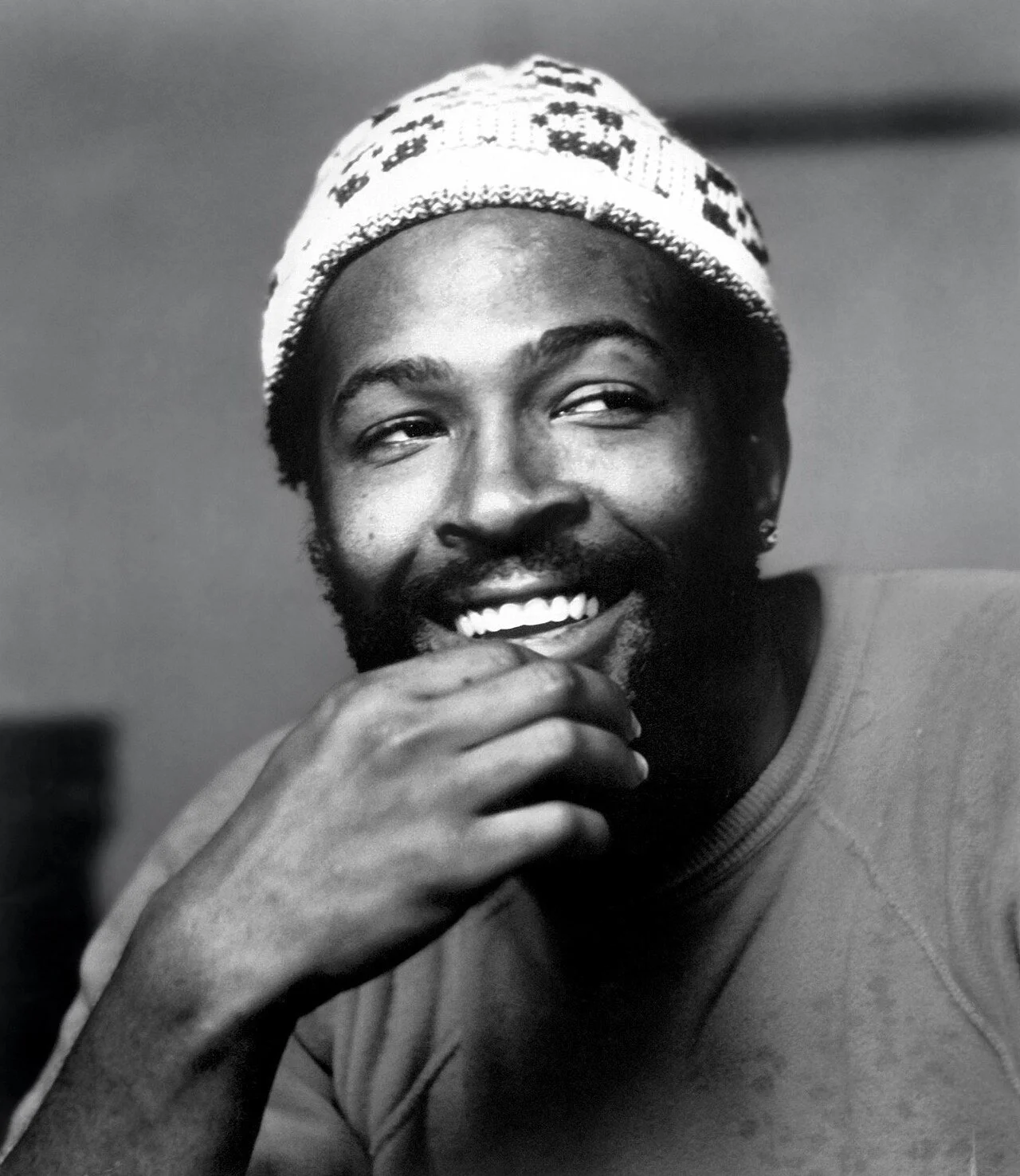
Marvin Gaye, 1973. Photograph by Jim Britt. Publicity photograph distributed by Motown Records. Public domain. Via Wikimedia Commons.
Motown Records
Marvin had already made quite a name for himself as one of Motown’s high-performing, chart-topping artists. Not an easy feat by any standards. But Marvin as a young boy had grown up singing in his father’s House of God church in Washington D.C. and developed a musical foundation that would stay with him for life. Gospel had given Marvin his first language of song, and that rich, church-born vocal style would go on to add a little butter to the Motown sauce.
Marvin’s introduction to Motown began behind the scenes. Initially working as a session drummer, he also toured for a time with The Miracles, fronted by Smokey Robinson. Sitting behind the band, however, was never likely to be where Marvin stayed. His charisma, sweet boyish looks and expansive vocal range were destined for the front of the stage.
History in the making, Berry Gordy would sign Marvin to Motown in 1961, and before long Marvin was building a reputation of his own.
His breakthrough came with Stubborn Kind of Fellow, followed by his first Top 10 hit, Pride and Joy. Then came the electrifying partnership with Tammi Terrell. Together they created some of Motown’s most enduring duets, including Ain’t No Mountain High Enough, establishing Marvin as a household name in R&B.
But behind the success, life was beginning to shift.
During a performance, Tammi collapsed onstage and into Marvin’s arms. It is difficult to imagine what that moment must have felt like for Marvin, witnessing it unfold in real time. She was subsequently diagnosed with a brain tumour and despite undergoing multiple surgeries continued to perform until passing in 1970, at the tender age of just 24. The loss impacted Marvin deeply, and according to PBS’s account of his life, vowed to never duet with another female artist again.
Marvin was already struggling with depression, and the grief of losing his stage partner, Tammi, came at a time when his own world was becoming increasingly sombre. The bright, high-energy love songs of his Motown years no longer seemed to tell the whole story.
His brother Frankie had served in Vietnam and returned home carrying the weight of what he had witnessed, whilst finding it hard to land a job. Frankie’s experiences, and the personal letters exchanged whilst Frankie was in Vietnam, would become deeply embedded in Marvin’s intimate reflections. Around him, America was also becoming increasingly volatile with outbursts of social unrest, racial tensions, police brutality, poverty, the anti-war movement and a growing sense of social upheaval were impossible for him to ignore.
“Something happened with me in that period and I had a strong urge to write music, write lyrics that touched the souls of men.”
What’s going On?
Four Tops member Renaldo “Obie” Benson was also questioning what was going on around him. While touring in Berkeley in 1969, Benson witnessed the violence surrounding the anti-war demonstrations at People’s Park, an event that became known as Bloody Thursday. The police response to the protesters stayed with him. He began asking himself: What is happening here? Why are we sending young men overseas to fight?
Benson brought those thoughts to Marvin. What began as Benson and songwriter Al Cleveland’s song would soon become something much bigger. Marvin took the melody and lyrics and began reshaping them, introducing a more conversational, compassionate voice and turning the song into something deeply personal. In hindsight, the song would reach a much larger audience, perfectly marinating in the times backed by Marvin’s buttery vocal delivery.
Marvin now had the fuel he needed to kick-start his own melody of truth, but he still had a few more hurdles to jump.
Motown chief Berry Gordy initially rejected the song. He considered it too political and worried about what it might mean for Marvin's career and Motown's carefully cultivated sound. Marvin, however, was standing by his truth. He refused to record anything else for Motown unless What's Going On single was released.
When it comes to your truth, stand your ground.
With Gordy resistant, Motown executives Harry Balk and Barney Ales took matters into their own hands. While Gordy was away, they authorised an initial pressing of 100,000 copies and sent the single to radio stations. The gamble paid off. The first batch single ‘What’s going on’ sold out almost immediately, another 100,000 copies were pressed, and the song became a major commercial success. It would eventually sell more than two million copies and become the fastest-selling Motown single of its time.
Truth had been delivered.
And listeners recognised something in it. The frustrations, uncertainty and social discord Marvin was singing about were not abstract political ideas. They were the things people were seeing and experiencing in their everyday lives. Perhaps this was the inspiration and the medicine, the ultimate unification between the people and the song.
Soul is in the song
Of course, Gordy was now inspired and eager for an album to be realised off the back of the new single's instant success. And so began the making of a concept album, What’s going on, that would become one of the most remembered in music history. Each song sequencing into the next, creating what became known as a “song cycle.”
In fact, the album was organic in its own development, with a number of accidental happenings feeding the soul of the record and making a definitive mark on its staying power.
For instance, engineer Kenneth Sands accidentally layered two of Marvin's vocals. Rather than discard the mistake, Marvin heard something in the accidental combination and embraced it as a unique sound. It became an early example of the vocal-stacking technique that would go on to become so influential.
Even the opening saxophone line came about by accident. Saxophonist Eli Fontaine had been warming up and improvised the now-iconic riff. Marvin heard it and decided it belonged on the record. What Fontaine thought was simply a warm-up became the opening sound of one of the most recognisable songs in popular music.
Fast forward more than fifty years, and What's Going Onhas unquestionably stood the test of time.
In the Rolling Stone magazine's 500 Greatest Albums list, the album landed the top spot at No. 1.
So what is it about this album that still reaches people more than half a century later?
Have we really made the progress we like to believe we have? Why do the same conversations about war, inequality, racial tension, police brutality, poverty, sustainability and the wellbeing of our communities continue to surface, generation after generation?
Perhaps that is the enduring power of Marvin Gaye's What's Going Onalbum.
It doesn't simply tell us what to think.
It asks us to feel.
And more importantly, it asks us to care.
Perhaps it also gives us permission to stop for a moment. To step away from the noise and consider what is happening around us — not necessarily from a place of anger, but from a place of curiosity, compassion and humanity.
Coffee, Marvin & a little Southern Hemisphere magic!
I'd just gotten back from travelling through Southeast Asia, which, of course, placed me straight into the jobless market.
Lucky for me, mutual friends were working at a café on Brunswick Street, Fitzroy, Le Gourmet. Whilst I didn't drink coffee at the time, I certainly knew how to serve up a gold-class brew.
The 6am starts were brutal. But I made it my own.
Each morning, as I eased into my shift, I put on What's Going On.
Six months. 6am. Every day.
That CD became part of the ritual. For those 35 minutes and 28 seconds, Marvin was sprinkled over the morning rush, the coffee machine, the regulars and the local cluster of customers who came through the door. It was my little circa-2006 ritual.
The mornings may have been brutal for that little cafe get up, but the coffee was hot and the music was delivered with a touch of question and a touch of church.
And somewhere between the churn of the coffee beans grinding, Marvin made a little magic with every golden brew served.
In the quiet corners of the world, there are still moments when we can question what we see, listen to another perspective and consider whether our actions are contributing to conflict or to unity.
For me, one of those quiet places happened to be a little café on Brunswick Street, Fitzroy, serving coffee with a smile.
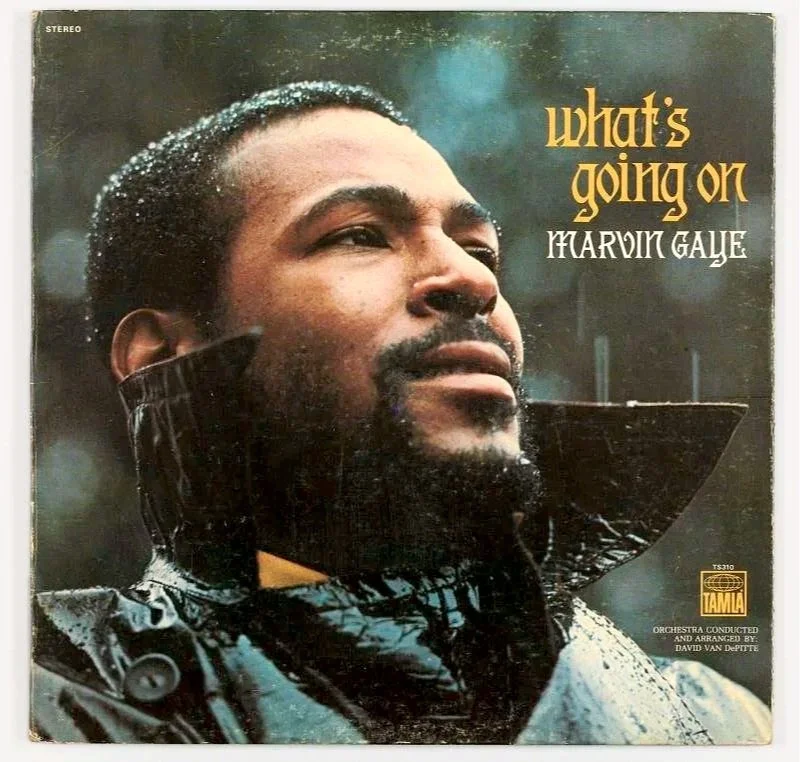
Marvin Gaye, What's Going On album jacket, 1971. Smithsonian National Museum of African American History & Culture.
And today….
Where to now?
It’s hard to believe the initial song, What’s Going On released back in 1971 never sparked an official video clip. This was made right back in 2019 with Universal Music Groups “Never Made” project. Savannah Leaf was selected to direct a video clip that addressed social issues such as protests, police brutality, and civil unrest to match the songs timeless message. Among the themes explored was the Flint Water Crisis.
What’s Going On sets a high standard for what can happen when an artist stands in their truth. Through song, Marvin Gaye moved generations and made an enduring impact, raising the idea that we can question the actions that create discord, separation and upheaval within our communities.
“As a whole individual, one should express what one feels, and what one feels inside one’s soul, as an artist.”