Talking Heads: This must be the place (naive melody)
A man walks onto a stage in a beige suit and white sneakers and places a boom box on the floor of a vacant stage.
Guitar in hand, David Byrne delivers a stripped-back version of ‘Psycho Killer’ as the stage behind him lies bare. With only the beat of the boom box supporting his acoustic guitar, the performance could almost be mistaken for a not-so-ordinary local open mic, until ‘Heaven’ begins, and bass player Tina Weymouth joins him, adding a deep, infectious groove.
A backing singer enters, adding another layer of flavour, and slowly the bare stage metamorphosis’s as the audience witnesses its moving parts falling into formation behind a captivating Byrne.
Coined as one of the greatest rock documentaries ever made, Stop Making Sense begins as a minimalist performance, gradually building anticipation as its lively unravelling of theatrics and musicality slowly blend together as a collective.
The concert turned theatre performance turned film gradually adds band members as each song makes its way through the setlist. Drummer Chris Frantz joins for the upbeat ‘Thank You for Sending Me an Angel’, followed by guitarist and keyboardist Jerry Harrison for ‘Found a Job’, completing the Talking Heads original-core band members.
Slowly, the audience witnesses the sound and energy growing more elaborate and alive as backing singers, congas and an additional guitarist complete the lineup.
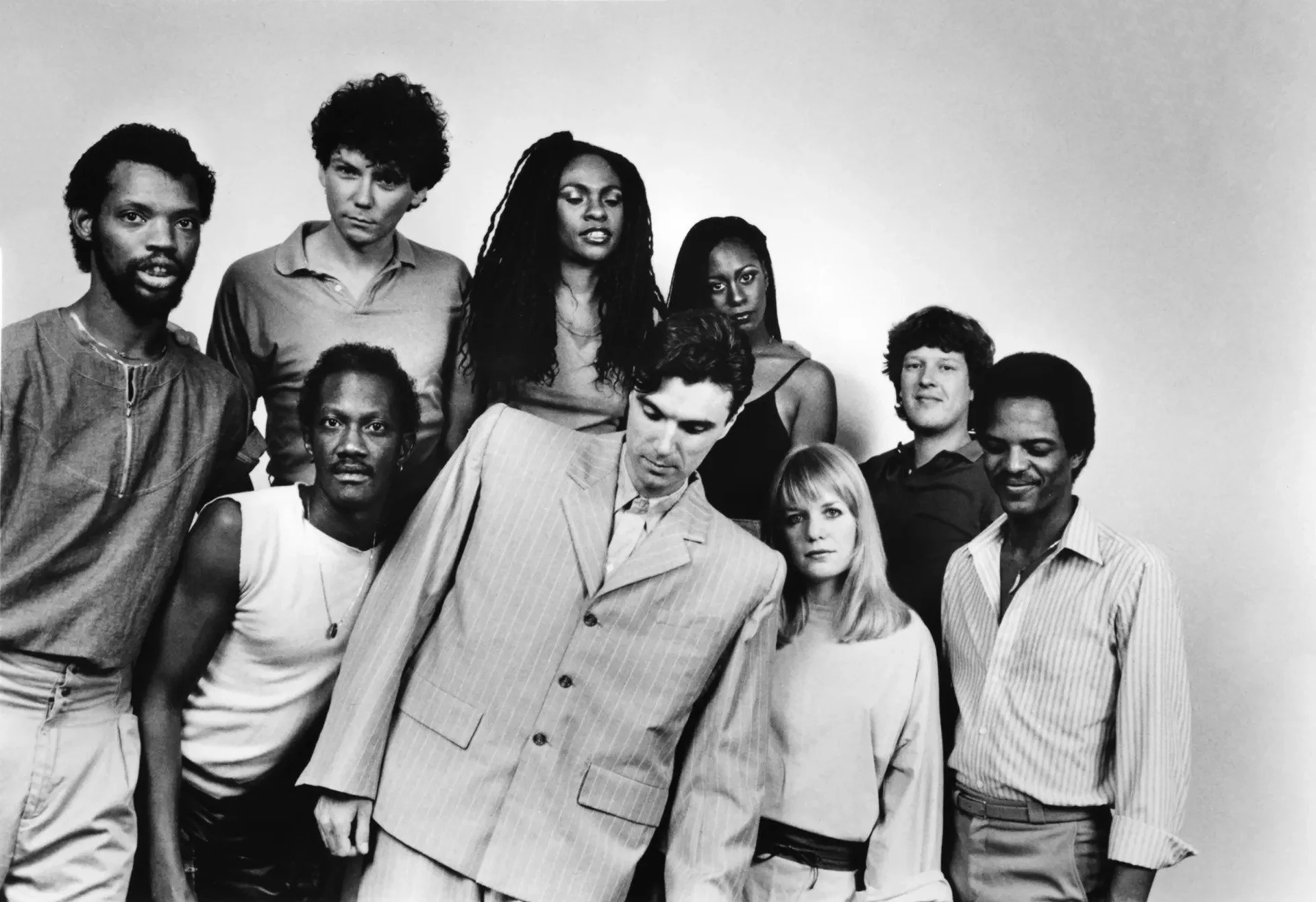
Stop Making Sense, Line Up
The nine-piece ensemble featured David Byrne, Tina Weymouth, Chris Frantz and Jerry Harrison alongside Bernie Worrell, Alex Weir, Steve Scales, Lynn Mabry and Ednah Holt.
The film was created from multiple performances over three nights, with the band selecting the strongest performances to create the final cut.
Talking Heads, 1984. Stop Making Sense press photograph. Sire Records / Getty Images. Public domain via Wikimedia Commons.
Inspired by David Byrne’s theatrical vision and director Jonathan Demme’s idea to transform it into a film, the band reportedly self-funded the project, raising US$1.2 million. We’re glad they did. Shot at the Pantages Theatre in 1983, the film stands decades later as a timeless theatrical music presentation, capturing Byrne’s charismatic energy and the unique musicality of each band member as they come together to create a sound that is both coherent and engaging.
At the time, Byrne was exploring traditional Japanese theatre, including Kabuki, Noh and Bunraku, alongside the avant-garde theatre scene in New York. Talking Heads were also experiencing a creative and commercial peak, building on the momentum of Fear of Music and Remain in Light, before releasing and promoting Speaking in Tongues in 1983. The album became their commercial breakthrough, with the band taking its expanded sound on tour that same year. The idea that infiltrates the film’s movement and theatricality was influenced by Byrne’s fascination with larger than life theatre, particularly the use of exaggerated gestures and costumes. This influence would famously manifest in the oversized suit Byrne wears, exaggerating his already captivating, almost “burn the house down” dance moves.
Byrne has gone on to say that he practised before the shows in his loft, experimenting with movement to discover what felt natural and organic on stage, rather than relying on formal choreography.
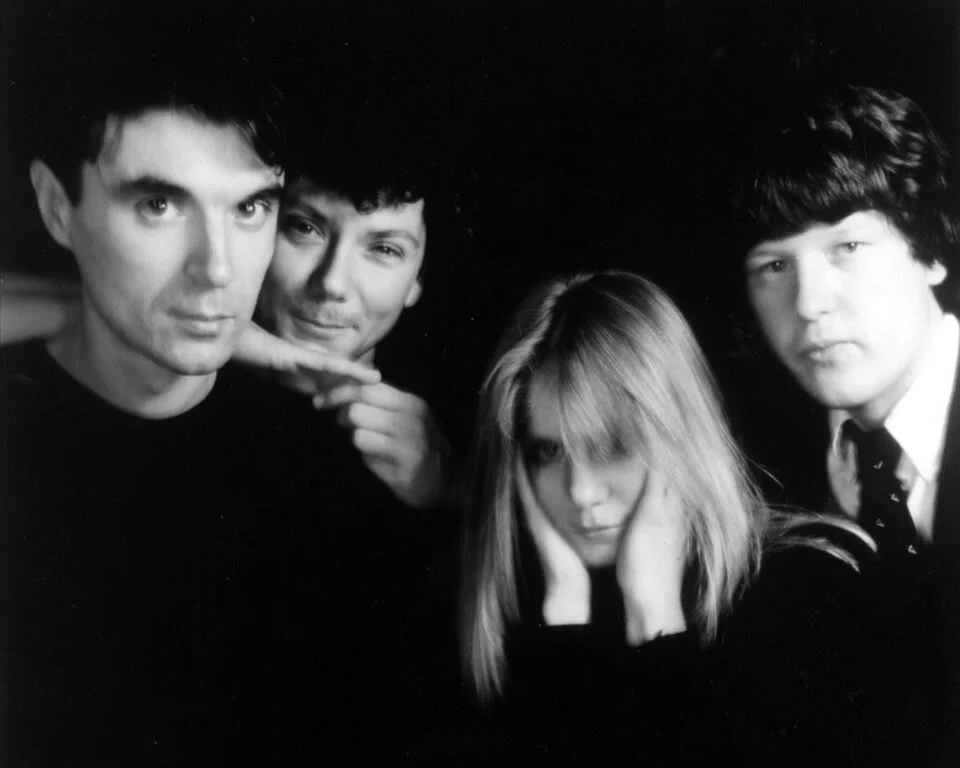
Talking Heads
This idea of building a performance as an artistic statement and layering multiple influences, pushing beyond previous experimental breakthroughs, was also evident in the development of their albums.
David Byrne, Chris Frantz and Tina Weymouth met at art school (Rhode Island School of Design (RISD)), with Chris recruiting Jerry Harrison to complete the band later on. This experimental spirit, the constant searching for something unique and new, would become central to the band’s collective output.
Talking Heads, 1980. Remain in Light publicity photograph. Sire Records; photographer uncredited. Wikimedia Commons. Public domain (U.S.).
For instance, David Byrne set out to write a love song, resulting in ‘This Must Be the Place (Naive Melody)’ after the band swapped instruments, stripping away familiarity and forcing them to build from a simple, repeating musical ostinato they considered ‘naive’. Abandoning the traditional chorus, the song instead develops around a hypnotic, single-chord groove. This approach of shaking things up with the deliberate intention of shifting the band’s dynamics breathed fresh air into the studio and their playing.
Experimentation would also be at the forefront of the band’s approach as their albums evolved, helping shape their unique sound. Remain in Light, released in 1980, explored rhythm, repetition, improvisation and studio technology, moving beyond the traditional guitar-driven confines of rock ’n’ roll. They had already begun breaking new ground with the previous record’s signature song, ‘I Zimbra’, which hinted at the rhythmic and experimental direction the band would pursue further.
The Idea!
Start with the groove, then flesh out the parts and stick with what feels like a cohesive sound for the band as a collective. These fragments, when combined, created new flavours born from trial and error — exactly what you might expect from such a highly experimental process.
"We didn't get it quite right, but in missing, we ended up with something new.” Byrne
Selecting the most compelling fragments and blending influences such as Afrobeat, funk, rock and experimental pop, the music took shape first, with lyrics and vocals becoming secondary elements that evolved from it.
This fresh way of working would go on to inspire bands such as Radiohead, who took their name from a Talking Heads album track. Thom Yorke has discussed how Remain in Light influenced the making of Kid A, particularly in the way the band approached playing and developed the music without having fully formed songs in advance, instead building the music as they went.
“That's exactly how I approached Kid A.” Yorke
Eddie Vedder of Pearl Jam also cited Talking Heads' evolution in sound as an inspiration. In a 1995 interview with SPIN, he reflected:
“I was thinking about what a masterful songwriter David Byrne is and was, but more importantly how the band interacted and how they seemed to grow over a period of the first five albums.”
And in a 2016 Vogue interview, when asked about the Pixies' biggest influences when they formed, Black Francis said:
“Probably bands like the Violent Femmes and Hüsker Dü. Talking Heads, Tom Waits. I think those are the biggies.”
And, “Dig for Fire,” from Bossanova (1990), has been described by Black Francis himself as:
“a bad Talking Heads imitation.”
One thing is for sure: Byrne’s voice contributes a unique vocal delivery, instantly recognisable as Talking Heads, while the band’s rhythm and groove provide the foundation for their experimental exploration. Together, these elements created the distinctive sound that has given the band such longevity. Their collective influences from the late ’70s and ’80s offer us a flashback to a musically progressive time, an era when artists openly layered less conventional influences to explore new musical territory.
Check out Byrne’s Big Suit performance in ‘My Girlfriend is Better’ on Stop Making Sense free on SBS On Demand