Radiohead: Transmitter
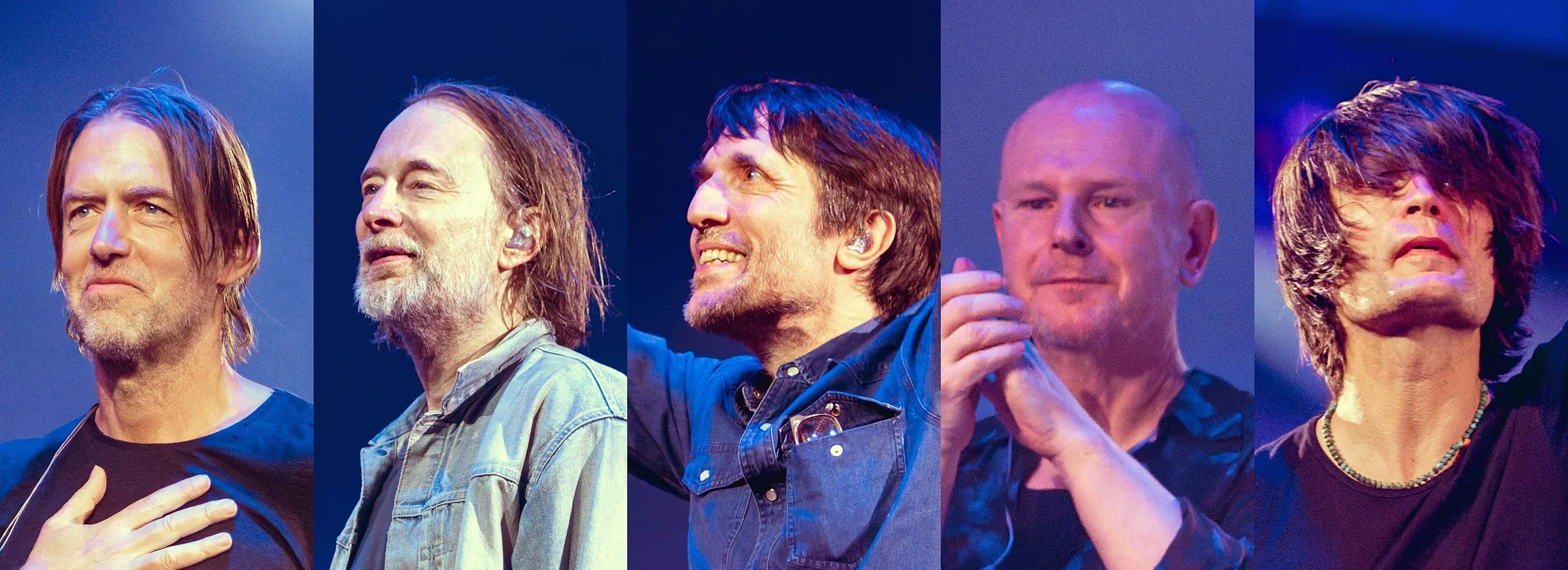
Image: Raph_PH, Radiohead — The O2, London, 21 November 2025, Wikimedia Commons, CC BY 4.0.
Orchestrating Frequencies, Breaking Sound Walls, Transmitting Ideas
Radiohead entered the musical arena on the right foot with their debut single ‘Creep’, from Pablo Honey (1993), achieving worldwide popularity. New to the pressures that came with sudden success, Radiohead followed with The Bends (1995), proving that their early success would not be categorised as that of a ‘one-hit wonder’.
‘High and Dry’ would also receive critical success, becoming one of their most streamed and enduring tracks to date. At the time, the band was distancing themselves from popular hits like ‘Creep’, but would make peace with it 20 years later, with the song returning to the setlist in 2016 and remaining thereafter. On the other hand, High and Dry would not be played live since ‘98.
Following The Bends, Thom Yorke was increasingly preoccupied by the rapidly changing technological landscape and the growing presence of computers in everyday life. The relentless touring cycle had also left him feeling disconnected and alienated. This would prove vital to the new material that would emerge on their next highly acclaimed album, OK Computer, released in 1997.
Widely regarded as one of the defining albums of its era, OK Computer captured the anxiety and alienation surrounding an increasingly technological world, while reflecting something of the end-of-millennium blues. The album went on to sell more than two million copies by the end of 1998.
However, relentless touring was taking its toll on Thom, resulting in a two-year writing block that stripped him of a vital creative outlet.
Thom has reflected on this period:
“It’s like losing someone you love.”
It’s hard to imagine the pressures that would take shape following the instant success of Creep, the follow up success of The Bends and then the highly respected third album, OK Computer. Where would the band go next? How would that take shape? Would they follow the guitar-driven sound that had been feeding their global success?
Kid A
Radiohead would reimagine their creative output again, beginning a dramatic change in the sound the band would orchestrate moving forward. Kid A incorporated elements of electronic music, IDM, Krautrock, free jazz and 20th-century classical music. The band moved away from dominant guitar riffs and traditional verse–chorus structures, embracing experimental sonic textures as a new direction that excited them and provided fresh sustenance for their creative exploration.
When I think back to this time, Kid A was well received by fans who appreciated sound as an art form, an open canvas of electronic, cinematic and ambient expansion. I for one was all here for the electronic abstraction, but it wasn’t for everyone.
The Letter
I found myself sitting outside in the courtyard of my shared townhouse in Fitzroy, Melbourne (circa 2001). I remember my boyfriend coming outside and asking, “What are you doing?” I had already been out there for two hours, not typical behaviour on a cold Melbourne day, but I needed some space and fresh air.
I replied, “I’m writing a letter to the journo at Beat Magazine who insists on bashing Radiohead’s Kid A every week. I’m over of it!”
It didn't stack — in the slightest.
My boyfriend simply shrugged his shoulders, “OK,” and walked back inside.
He knew this was bigger than him.
-
Whilst I understood that an album may not be everyone's cup of tea, I couldn't understand the relentless targeting and weightless ground for the cheap weekly shots. That night at dinner, my boyfriend asked, “So, did you send the letter?”
“No,” I replied.
“You spent three hours writing a letter and didn't post it?” he replied, astonished.
“If I send this letter, his ego will explode and he'll have a field day next week at my expense. I'm not giving him the fuel for further jabs.” I replied, completely feeling fulfilled from the days activities.
I realised I felt a tonne better simply from writing the letter, and never again gave that column an ounce of my time. I mean, I'm not even a fan-fan (I wasn’t a part of any club), and yet I found myself spending three hours writing a letter that ultimately ended up in the can! I just couldn’t understand how this album, Kid A, deserved this kind of bashing. It was an art piece in my eyes. Looking back, I can appreciate my feisty angst back then. These days, I'm a little more unbothered by most things.
Radiohead would not release any singles from Kid A, but the album would go on to reach No.1 in the US.
Dystopian Landscapes to the Labyrinth
The band would follow up with Amnesiac (2001), Hail to the Thief (2003) and In Rainbows (2007).
Early on Thom Yorke had met an art school friend, Stanley Donwood, at Exeter University. This would forge a collaboration that saw Donwood provide the art for Radiohead throughout their career. However, during the change of course with Kid A, Donwood had become tired of the increasingly digital direction of his previous work for Radiohead and decided to hire a studio and bring in large canvases to explore materiality and texture.
This new direction provided a turning point for both Kid A and Amnesiac, with Donwood creating the physical paintings and Yorke manipulating them digitally. Where Kid A explored vast dystopian landscapes of fire, ice and looming catastrophe, Amnesiac turned inward, into maps, labyrinths and the tragic figure of the Minotaur.
Yorke has described returning to painting during this period as “absolutely terrifying.” Having previously expressed his hang-ups around his earlier art-school education, Yorke had begun to make peace with the idea that the musician could also exist within the traditional art space — challenging the perceived separation between the two.
Side Projects
During this period, the Radiohead ecosystem began to expand, with band members venturing into their own solo projects & collaborations.
-
Jonny Greenwood would be the first to venture beyond the Radiohead sphere, expanding into film scores, musical compositions and contemporary classical music. His first collaboration with filmmaker Paul Thomas Anderson began with There Will Be Blood (2007), eventually leading to scores for The Master, Inherent Vice and Phantom Thread, among other projects. His work would continue to expand beyond film, eventually leading to collaborations such as Junun with Shye Ben Tzur and the Rajasthan Express, before later forming The Smile with Thom Yorke and Tom Skinner.
Interesting fact: Filmmaker Paul Thomas Anderson is a huge Radiohead and Jonny Greenwood fan. Their creative relationship extended beyond film scoring: Anderson directed three music videos for A Moon Shaped Pool (2016) — Daydreaming, Present Tense and The Numbers. He also documented the making of Junun, Greenwood's collaboration with Shye Ben Tzur and the Rajasthan Express.
You can check out Junun: “Hu” (Film Outtake), where Shye Ben Tzur, Jonny Greenwood and the Rajasthan Express perform “Hu” from Junun. The footage comes from Anderson's film documenting the album's recording sessions.
-
Would also begin building his own parallel musical language, releasing solo projects including The Eraser, Tomorrow’s Modern Boxes and ANIMA. He would also collaborate with Flea of Red Hot Chili Peppers through Atoms for Peace, releasing AMOK, while continuing to explore collaborative work beyond Radiohead. More recently reuniting with Flea creatively on “Traffic Lights”, from Flea’s 2026 jazz album Honora. Co-written by Flea, Thom Yorke and producer Josh Johnson, the track features Yorke on vocals, piano and synthesise.
You can check out York and Stanley Donwood’s art and current/ upcoming exhibitions at Tin Man Art.
-
Under the name EOB, released Santa Teresa in 2019, followed by his debut album Earth in 2020. His solo project would create another branch of the Radiohead ecosystem, distinct from both Yorke and Greenwood's electronic and experimental directions.
-
Turned songs he had begun writing as a teenager into his solo debut Familial (2010), followed by Weatherhouse (2014) and Strange Dance (2023).
-
Contributed bass to projects outside Radiohead and working with artists including Tamino and Nick Cave and the Bad Seeds. He also brought another creative practice into the ecosystem through photography, releasing How to Disappear: A Portrait of Radiohead in 2024, a collection of two decades of photographs documenting the band's life on stage, backstage, and in the studio.
Pay What You Want
Radiohead released their seventh studio album, In Rainbows (2007), with a pay-what-you-feel model that allowed fans to download the album directly from their website for whatever price they thought it was worth. The unconventional approach generated enormous attention, and within a year, In Rainbows had reached around 3 million sales across downloads, physical albums and the limited-edition box set. The following album, The King of Limbs (2011), returned to a more conventional release and purchasing model, making In Rainbows a particularly distinctive release in Radiohead's catalogue and in the changing landscape of digital music.
Today A Moon Shaped Pool remains Radiohead's most recent studio album, released in 2016. This album embraces a more intimate and reflective style that blended new material, and songs that had been sitting within the Radiohead archive for years. Burn the Witch had existed in some form since the Kid A era, while True Love Waits dated back to the mid-1990s. Reworked through the band's evolved musical language, these older fragments found a new life.
One thing I admire about Radiohead is their fearless navigation of sound, and the fact that they are still together. Plenty of bands have split over time, and sadly some have lost members. Radiohead has weathered the storms, remained fresh within the Radiohead ecosystem and continued to evolve outside it as creative individuals.
And now, after 15 years, Radiohead are returning to Australia for a massive run of shows in 2027. All 16 Australian shows are now officially sold out.
If you got a ticket, lucky you!
How is it that there were 12 shows scheduled for Sydney and Melbourne and I still couldn't land a ticket?