Picasso: Shatter the Image, Rewrite the World
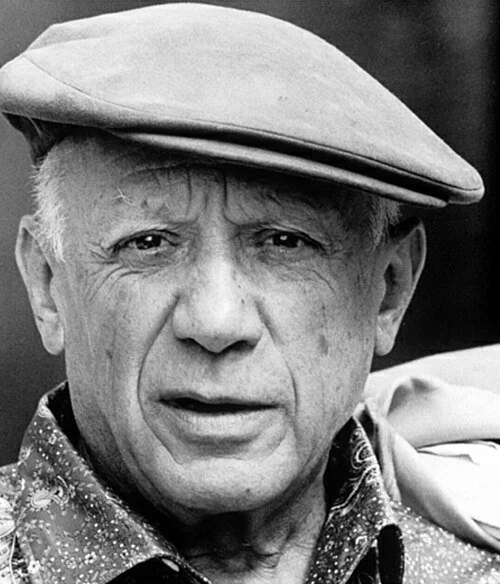
Pablo Picasso: 1881-1973
Born in Malaga, Spain.
The Canon: The Museu Picasso in Barcelona houses more than 4,200 works, offering a significant window into Picasso’s artistic development. However, his lifetime output extends far beyond the museum’s collection, spanning painting, drawing, sculpture, ceramics, prints, engravings and poetry.
'Zervos' Catalogue Raisonné, a 33-volume scholarly reference developed in collaboration with Picasso, reproduces and documents more than 16,000 images of his paintings and drawings.
Picasso, P. (1962). Pablo Picasso wearing a flat cap [Photograph]. Revista Vea y Lea, Argentina.
Pablo Blasco
Known as the forefather of Cubism and a pioneer of collage, Pablo Picasso began honing his craft long before he would become one of the most influential artists of the twentieth century. Mesmerised by his father's classical painting, he closely observed his father, José Ruiz y Blasco, a painter and art teacher, at work. Considered a child prodigy, Picasso developed a remarkable command of detail, composition and perspective under his father's guidance, demonstrating an ability that far exceeded his years.
So determined was the young Pablo to pursue his art that he reportedly insisted on being allowed to draw in class if he was to attend school. Attentive to interpreting the external world through the lens of an artist, and bring the same determination as a young boy, Pablo set out to learn and master his father's craft. At just 15, he received an honourable mention for the painting, Science and Charity (Ciencia y caridad, 1897) at the National Exhibition of Fine Arts in Madrid. His career appeared assured.
His father would also frequently feature as a subject in Picasso's paintings, including The First Communion (1896), for which father and son chose the subject. Pablo appeared destined to become a great classical painter, much to his father's delight, perhaps even becoming a celebrated academic artist, or so his father thought.
However, something else was stirring deeply within Pablo, driving his creative dreams and his desire to explore new ground. As much as he perfected the art of classical painting, he yearned to carve out his own path and embrace innovation, and break new ground in the process. The likes of El Greco, Vincent van Gogh and Henri de Toulouse-Lautrec would draw Picasso towards a more unconventional way of seeing and painting the external world.
With a desire to disrupt the artistic field and conquer new territory, Picasso and his friend Carles (Carlos) Casagemas travelled from Barcelona to Paris in 1900, the artistic centre of excellence. They shared a studio and immersed themselves in the city's bohemian culture and social circles. During this period, Picasso increasingly adopted his mother's maiden name as his artistic surname, to forge an identity of his own, distinct from his father's traditional artistic focus. Picasso wanted to be the greatest artist of all time.
Picasso
“My mother said to me, 'If you are a soldier, you will become a general. If you are a monk, you will become the Pope.' Instead, I was a painter, and became Picasso.” — Pablo Picasso
Now immersed in the Parisian scene, Picasso was a young man keen to broaden his creative direction and earn an income. Fortunately, Catalan art dealer Pere Mañach recognised his talent and offered him a contract worth 150 francs per month in exchange for his artistic production and representation. This arrangement helped Picasso support himself while living abroad and establishing his career.
However, amidst his painting and the growing recognition of his artistic abilities, Picasso would be met with tragedy while holidaying in Madrid, Spain in 1901. Pablo received word that his beloved friend Carles (Carlos) Casagemas, caught in the midst of unrequited love for the model Germaine, had met a tragic end. At a farewell dinner in Paris, Casagemas attempted to shoot Germaine, thankfully missing her, before turning the gun on himself, believing he had killed the woman he loved. It was a devastating and distorted final act born out of despair.
This was not the first time Picasso had encountered death in the form of personal tragedy. His family had endured the loss of his younger sister, Conchita Ruiz Picasso, who died of diphtheria when he was just 13 years old. The loss undoubtedly impacted the family deeply, and one can only imagine the grief they experienced. For Picasso, this may have been an early impactful experience in which art became a means of processing tragedy, loss and the inevitable pain of losing someone you love.
Picasso reportedly prayed that Conchita would recover and vowed to give up painting if she survived. She did not, and the experience has often been described as a profound childhood trauma.
The Blue Period
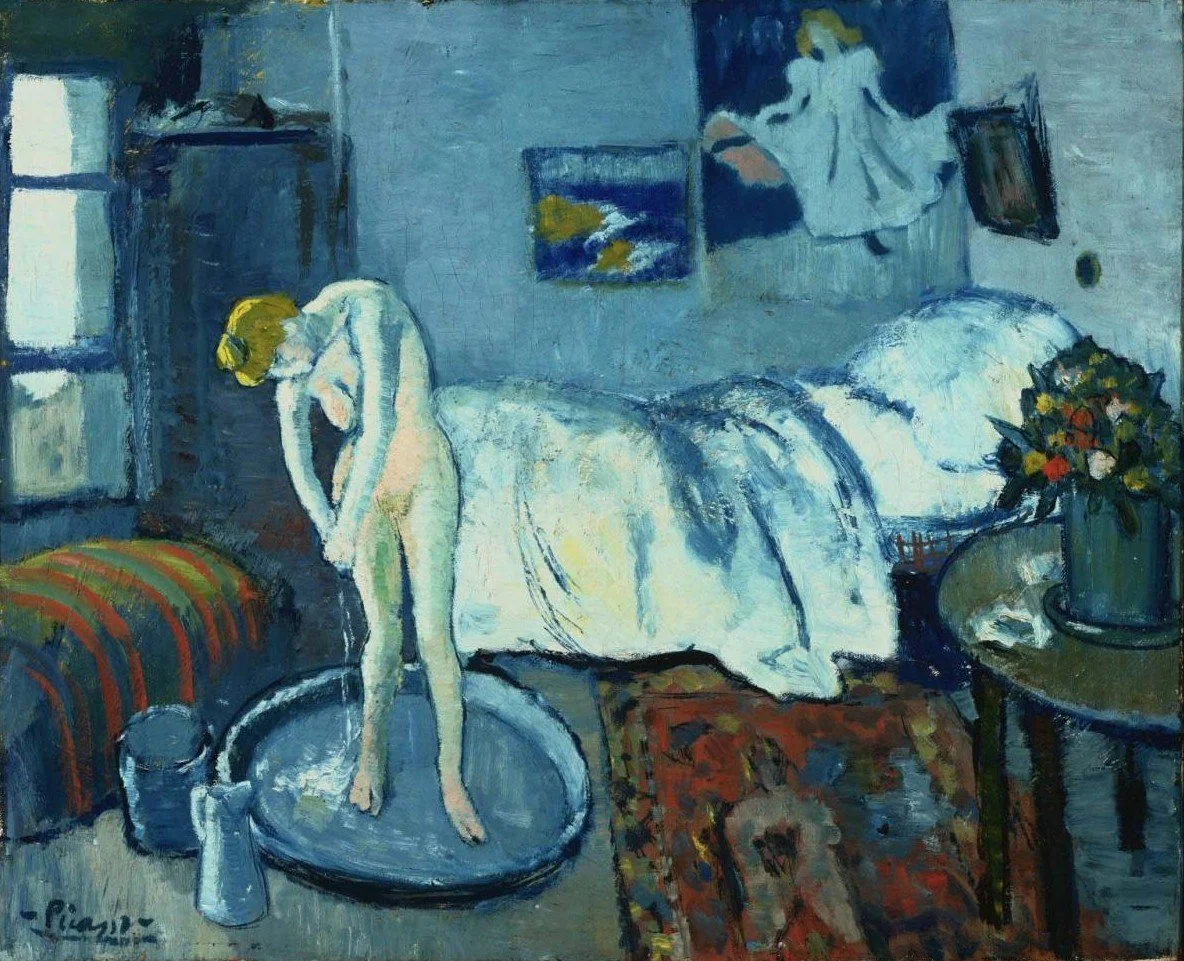
Returning to Paris, Picasso entered a new chapter in his artistic journey, marking the beginning of what would become known as his Blue Period (1901–1904).
Picasso would come to explore how emotion could be conveyed on canvas, drawing on personal experience to process grief, loss and human vulnerability. This is evident in three works: 1. The Old Guitarist (1903–04), conveying sorrow, poverty and human vulnerability; 2. La Vie (1903), an emotionally complex composition depicting a naked man and woman facing a woman holding a baby, with a hunched couple embraced in the background, evoking themes of despair and human suffering; and 3. The Death of Casagemas (1901), one of Picasso's early works associated with the beginning of his Blue Period.
Pablo Picasso, The Blue Room (1901). Oil on canvas. Collection of The Phillips Collection, Washington, D.C. Image source: Wikimedia Commons. Public-domain reproduction in the United States. View image and licensing details.
Haunted by death and tragedy, Picasso turned his attention to themes of poverty, isolation and human suffering, depicting beggars and the marginalised while struggling to sell his paintings during this three-year period. Pivotal to his creative evolution, this period would challenge him to move beyond technical mastery. Could he evoke emotion through his brushstrokes and convey humanity in its rawest, most vulnerable form?
Returning to Barcelona to seek the support of his family once again, Picasso eventually decided to close this chapter and relocate permanently to Paris in 1904.
Rose Period
Back in Paris, colour slowly began to return to Picasso’s work. His new companion and muse, French model Fernande Olivier, moved into his studio, and a sense of domestic bliss would mark a new period: The Rose Period (1904–1906). For example, a Boy with a Pipe (1905). Meanwhile, he continued working on his French, gradually settling into the Parisian scene once and for all.
In 1905, fateful events would bring American novelist, poet, playwright, and art collector, Gertrude Stein into Picasso’s studio, where she purchased ten paintings for 800 francs. This support helped ease Picasso’s financial pressures and he offered, in addition, to paint her portrait, Portrait of Gertrude Stein (1905). She agreed, but the process would prove challenging, as Picasso found it impossible to capture her face to his satisfaction.
When studio portraiture proved fruitless, he began to sketch and paint without Gertrude present, eventually completing the portrait from memory. In his portrait of Gertrude Stein, Picasso moved beyond conventional likeness, giving her face an almost mask-like quality influenced by ancient Iberian sculpture and, more broadly, the abstract forms of African art. Her face was strong and angular, hinting at future painterly developments and the mask-like forms that would emerge in his work.
Initially, Gertrude did not favour or appreciate the representation. Picasso reportedly offered reassuring words, suggesting that although she might not recognise herself in the portrait now, she would eventually come to embody its significance — a future High Priestess of Art.
Gertrude would go on to hang her portrait alongside works by the great artists who had inspired Picasso and shaped the artistic landscape around him, including nineteenth-century masters Henri Matisse, Paul Cézanne, Pierre-Auguste Renoir, Henri de Toulouse-Lautrec, Édouard Manet, Eugène Delacroix, Honoré Daumier and El Greco, as well as artists of a later generation, including Maurice Denis, Juan Gris and Georges Braque.
“Only one person has the right to criticize me. It’s Picasso.“ — Henri Matisse
After painting his breakthrough work, Les Demoiselles d’Avignon (The Young Ladies of Avignon, 1907), depicting five women associated with a brothel in Barcelona, Picasso hinted at what was to come.
CUBISM
“The world today doesn't make sense, so why should I paint pictures that do?” — Pablo Picasso
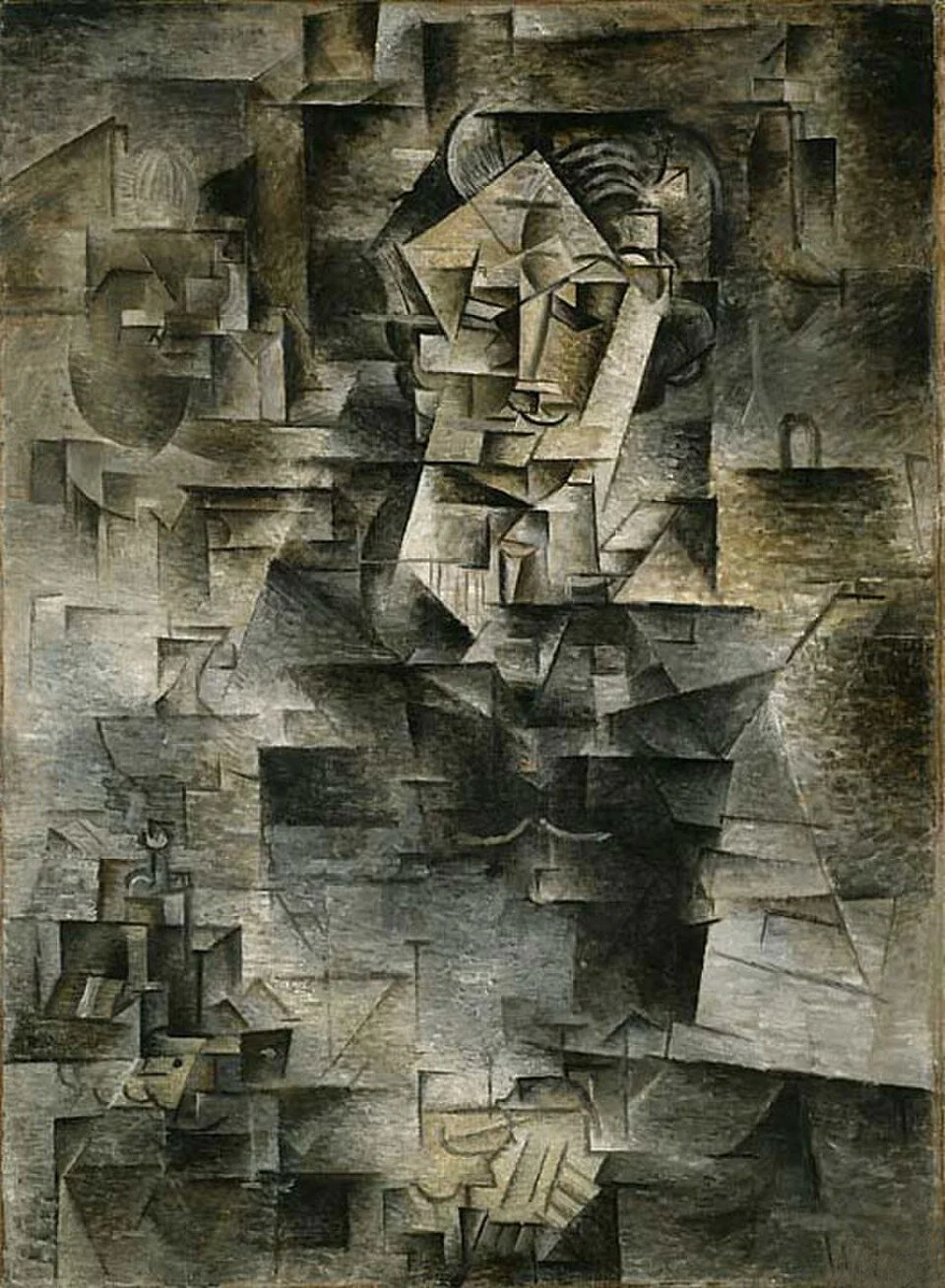
Portrait of Daniel-Henry Kahnweiler (1910)
His ambition was no longer simply to paint the world as it appeared, but to explore how it might be seen, fractured and reconstructed.
What followed was an endless deep dive into reconstructing the parts that determine the whole — Cubism.
At the time Picasso and Georges Braque worked closely together, exchanging ideas and questioning the very language of painting: perspective, depth, shape, space, and the relationship between an object and its representation.
This period would establish Picasso as an innovator, making his mark on the art world through a movement that reflected the changing times and challenged the status quo.
Proto-Cubism → Analytic Cubism → Synthetic Cubism → Neoclassical Period → Surrealist Influence → and then,
Pablo Picasso, Portrait of Daniel-Henry Kahnweiler (1910). Oil on canvas. Art Institute of Chicago. Image source: Wikimedia Commons.
Guernica
.
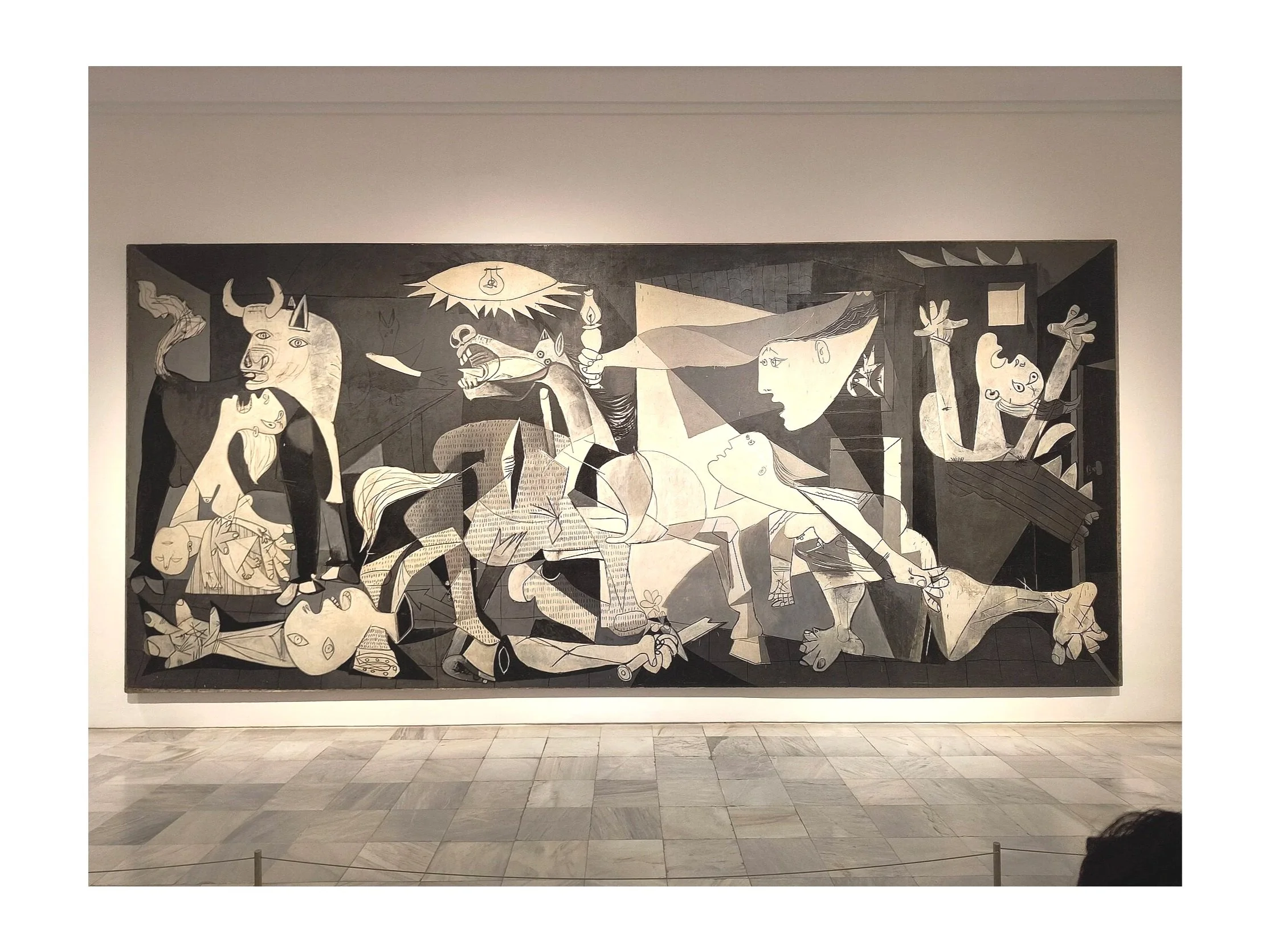
Pablo Picasso, Guernica (1937). Photograph of the painting at Museo Nacional Centro de Arte Reina Sofía, Madrid. Photograph by Görkem Yavuz (2024). Image source: Wikimedia Commons. Licensed under CC BY-SA 4.0.
Guernica (1937) was commissioned by the Spanish Republican government for the Spanish Pavilion at the 1937 Paris International Exposition. Although Picasso had reservations about engaging with a political subject, he was deeply horrified by the bombing of Guernica on 26 April 1937 by German and Italian forces supporting Franco’s Nationalist side during the Spanish Civil War. He made the atrocity the subject of his painting, creating a monumental canvas measuring 7.76 metres wide and 3.49 metres high. Painted in monochrome, the work echoed the black and white newspaper imagery through which news of the devastation spread.
Becoming a powerful symbol of anti-war sentiment, Guernica demonstrated how an artist’s work could represent human suffering and move viewers to question the nature of atrocity and the causes for which people go to war.
Guernica moved beyond the event that inspired it to become a universal indictment of war — a monumental painting that transformed Picasso’s fractured visual language into a public expression of grief, protest and human suffering.
In the same year, he painted ‘The Weeping Woman’ (1937). The woman’s face is distorted into sharp, fragmented forms, with her handkerchief held to her mouth as she cries. Her anguish becomes almost unbearable to look at. Uncomfortable to the viewer, the work also reflects the time that conveys the anguish of war.
“Art washes away from the soul the dust of everyday life.” — Pablo Picasso
Reconstruction
Picasso’s canon extends far beyond these pieces and movements explored, spanning paintings, sculpture, ceramics, prints and poetry. His work continued to evolve throughout his life, refusing to settle into one style or a single way of seeing.
Yet Guernica leaves us with something beyond the image itself. A fractured world, people in pain and poverty, the devastating consequences of violence — all brought into view so that we cannot simply look away.
Perhaps this is where the act of reconstruction begins. In recognising what has been broken, in questioning the forces that broke it, and in finding the courage to imagine something different.
We can pick up the pieces at any time in our lives. We can look again, reconsider what we thought we knew, and reimagine new meaning from what remains.
To shatter the image is not simply to destroy it. It is to open up the possibility of seeing ourselves and the world anew.
How can we learn from Picasso’s artistic compass in a changing world?
Embrace change and take the lead.
If your field is unravelling before your eyes, take the lead. Unravel at speed, pivot and move towards a uniquely reimagined path.
Move towards what cannot be replicated.
When external forces make you question your value, recognise the qualities that distinguish you. Build on what makes your perspective unique, and step into your own power.
Resist the boundaries of a single discipline.
Merge disciplines that expand your landscape, challenge your comfort zone and allow you to create something new. Innovation often happens where different ways of seeing intersect.
Honour your process when navigating grief and find meaning in what remains.
Grief and change unfold differently for everyone. Give yourself the space to process what has been lost, reconnect with what matters and discover new meaning in what remains. Take the time you need as your heart heals, allowing new forms of expression to emerge and illuminate connections that may have felt distant.
Let truth be your compass, and connection your catalyst.
Standing in your truth is a compass for moving forward. Connecting with people who challenge your thinking, understand your perspective and expand the way you see the world can elevate your work and broaden your horizons beyond measure. Picasso’s relationships with fellow artists, writers and patrons helped create an environment of exchange, experimentation and creative possibility.