Mr Lynch: Will You Be My Guardian Angel?
"Through the darkness of future past, the magician longs to see. One chance out between two worlds... Fire walk with me!"
If you're Generation X like me, you'll remember standing between two worlds, an analogue childhood gradually shifting into a digital adulthood. We grew up with Saturday morning cartoons like The Jetsons, The Smurfs and Teenage Mutant Ninja Turtles. MTV arrived and suddenly music had images. Here in Australia, weekends weren't complete without Rage, staying up late or waking up early to catch the Top Ten countdown. We fixed cassette tapes with pencils after they had unravelled, disappeared into nature for hours, and learnt to entertain ourselves when boredom inevitably arrived.
We found ways to earn pocket money for the next blockbuster movie release, the latest cassette for the boombox, or a magazine whose free poster would proudly decorate our bedroom wall. It was a slower world, one that encouraged imagination to wander.
Amid this familiar pop culture was a strong shade of artistic brilliance weaving its way through this era, one darker, stranger and infinitely more mysterious. A filmmaker named David Lynch quietly entered our suburban lounge rooms through the weekly television series Twin Peaks. Every episode felt unlike anything we had seen before: mystery without easy answers, beauty entangled with terror, and a dreamlike world where nothing was quite what it seemed. The surreal tale of Laura Palmer became part of my teenage years.
By this time Lynch had already directed Eraserhead (1977), The Elephant Man (1980), Blue Velvet (1986) and Wild at Heart (1990). He would later create Lost Highway (1997), Mulholland Drive (2001) and Inland Empire (2006), each deepening his unique cinematic language, otherwise known as the Lynchian cinematic style.
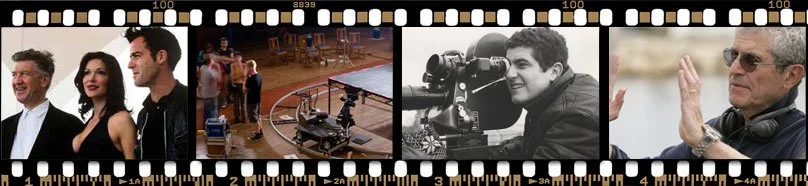
Image credit: PortailRealisationFooter.jpg, created by Dereckson, via Wikimedia Commons. Licensed under Creative Commons Attribution-ShareAlike 3.0 (CC BY-SA 3.0).
While Twin Peaks coloured my adolescence, it wasn't until much later around 2002, that David Lynch quietly returned to my life.
At the time I was living in a share house on George Street in Fitzroy, Melbourne, while studying oil painting at art school. On the second-storey terrace hung a portrait of Isabella Rossellini from Blue Velvet. It had been left behind by previous tenants, as though waiting for the next artist to find it. I left it hanging for the entire time I lived there. Perhaps it became a quiet guardian for every creative soul who occupied that house afterwards.
I should say that I have never considered myself a "Lynchian" fan, fan. Many passionate film lovers know his cinematic universe far more intimately than I ever will. What captivated me wasn't simply his films. It was listening to David Lynch speak about creativity, consciousness, painting, music and the artistic life. His interviews fascinated me just as much as his films. I felt completely aligned with his inspirational words shared. His reflections resonated deeply with my own creative practice, particularly because meditation had already become an important foundation in my life.
Around the same time I discovered his lecture David Lynch on Consciousness, Creativity and the Brain (2009), I was working at a local council where the General Manager offered staff the opportunity to learn Transcendental Meditation. Looking back, it feels like another of those remarkable synchronicities that Lynch often spoke about. Suddenly I now had my own TM mantra, and it became a generous backbone to my creative practice. You can learn the meditation technique at the David Lynch Foundation.
Lynch's words accompanied me from that point onwards, colouring both my internal and external worlds.
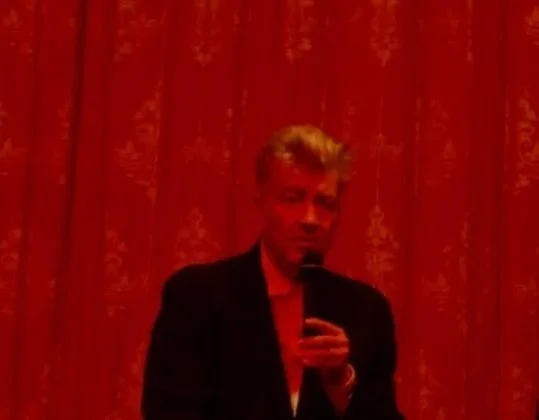
One insight has remained with me ever since:
"Ideas are like fish. If you want to catch little fish, you can stay in the shallow water. But if you want to catch the big fish, you've got to go deeper. Down deep, the fish are more powerful and more pure. They're huge and abstract. And they're very beautiful."
— Catching the Big Fish (2006), David Lynch.
Photo by cuttlefish, licensed CC BY 2.0 via Wikimedia Commons.
What has always fascinated me most about David Lynch isn't simply his body of work. It's the seemingly ordinary encounters that quietly redirected his life. At fifteen years old, a childhood friend named Toby Keeler often spoke about his father, Bushnell Keeler, a professional painter who worked from his own studio. This captivated Lynch and he couldn't shake the idea.
People could actually spend their lives painting?
Eventually he visited Bushnell's studio and became mesmerised by the smell of oil paint, the brushes, canvases and the quiet atmosphere of artistic dedication. That experience ignited a lifelong love affair with painting. Long before he ever imagined making films, Lynch considered himself a painter first, and painting remained central to his creative life for decades.
Years later, while studying at the Pennsylvania Academy of the Fine Arts, Lynch confessed to a friend that he wished his paintings could move rather than remain still. The friend simply replied: "Why don't you make films?" It was such an ordinary sentence, yet it altered the course of an extraordinary life. Soon afterwards Lynch created his first experimental short film, Six Men Getting Sick (Six Times), before eventually studying at the American Film Institute Conservatory, where he developed Eraserhead.
Then another conversation changed everything.
In 1973, at twenty-seven years of age, Lynch's sister suggested he learn Transcendental Meditation. At the time he was overwhelmed. Eraserhead was progressing painfully slow due to a lack of funding. He was juggling odd jobs to support his young family while his first marriage was breaking down. He later remarked that after his very first meditation session, it felt as though a great weight had been lifted from his shoulders. He had found himself less fearful, less angry, and more able to focus on his work. He would go on to practise Transcendental Meditation twice every day for more than fifty years.
Looking back over both David Lynch's journey and my own, I can't help but notice how many lives are quietly redirected by simple conversations. A childhood friend introduces you to an artist's studio. A fellow student casually suggests making films. A sister recommends meditation. A forgotten movie poster waits on the terrace of a share house. A workplace unexpectedly offers meditation training. None of these moments appear extraordinary at the time. Yet together they become turning points.
Perhaps that is how guardian angels really arrive, not with wings, but disguised as conversations, chance encounters and quiet invitations that gently redirect the course of our lives.
"Keep your eye on the doughnut, not the hole." David Lynch
In a world increasingly distracted by noise, certainty and speed, Lynch gently encouraged us to remain curious, to trust intuition, to protect our creativity and to dive beneath the surface in search of the ‘big fish’. Perhaps that was his greatest gift. Not simply the films he left behind, but the permission he gave us to discover our own creative worlds.

You can sign up to access our Free Intuitive Art as Medicine eCourse.
Experiment, be curious and create a space where your intuition can express freely through our creative arts processes.